1

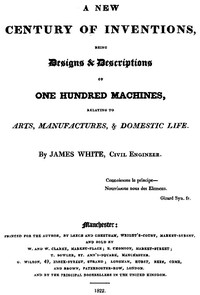
A New Century of Inventions Being Designs & Descriptions of One Hundred Machines, Relating to Arts, Manufactures, & Domestic Life — Context and Discussion
3
0
Project Gutenberg
2013
Machinery
Readers of public-domain and historical texts
Project Gutenberg digital edition
en
Edition facts
Words: 100,812
Reading time: 439 min
Text sections: 16
Source:
Project Gutenberg record #42951
James White's 1822 collection of one hundred machine designs, each with detailed mechanical descriptions and plates, offers a window into early 19th-century engineering thought. The preface reveals a personal urgency to publish before declining health prevents him, while the technical entries blend precise geometry with practical innovation.
James White opens his 1822 volume with a preface that is as much personal testament as technical introduction. He confesses to a long hesitation about publishing, fearing his ability might be 'extinct before I could do it at all.' The work is explicitly modeled on the Marquis of Worcester's earlier 'Century of Inventions,' yet White distinguishes his approach: his machines are 'distinct objects of immediate application' rather than a systematic treatise. This tension between the personal and the practical sets the tone for what follows—a collection that is both a legacy and a toolbox.
A Preface of Urgency and Modesty
White's preface reveals a man aware of his own mortality. He writes of 'declining health' and the approach of 'that night in which no man can work,' framing the book as a final contribution to the 'treasury of human knowledge.' He does not claim his inventions form a 'regular System of Mechanical truth,' but rather offers them as useful fragments. This humility is strategic: it lowers expectations while inviting future engineers to build on his ideas. The preface also names his predecessor, the Marquis of Worcester, whose example White hopes will 'prolong the remembrance of mine.' This is not false modesty but a clear-eyed assessment of his place in a lineage of inventors.
The Helico-Centrifugal Machine: Water Raised by Its Own Force
One of the earliest technical descriptions is the 'Helico-centrifugal Machine' for raising water. White explains that the water rises not by a pump but by 'its own centrifugal force, combined with the revolution of the screws.' The screws act as 'wedges' against the water's outward tendency, lifting it until it spills into a ring canal. He notes that the machine 'gives no shock to the water' and that its perfection depends on 'a due relation between the centrifugal force, and the sine of the angle' of the screw threads. This is not a vague sketch: White provides specific geometry, including the role of wheels and valves at the bottom of each screw to prevent backflow when the machine stops. The description is dense with cross-references to figures and plates, demanding careful reading.
A Forging Machine That Strikes by Pressure
White's forging machine replaces the traditional hammer with 'pressure instead of percussion,' yet the pressure is 'so instantaneous as to resemble a blow.' The design uses two crank shafts with bevel wheels, ensuring synchronized motion. The metal is compressed between two surfaces set at right angles, with rollers on eccentric arms delivering repeated impacts. White's language here is terse and mechanical: 'It is thus evident that the two crank shafts B, C, will make the same number of revolutions.' He assumes the reader can follow the geometry from the plate. The description is typical of the book's style—functional, precise, and reliant on the accompanying illustrations for full comprehension.
Reading the Plates and the Text Together
The excerpts make clear that White's text is incomplete without the plates. He repeatedly directs the reader to figures: 'shewn by a section only at e f,' 'marked with the same letters in fig. 2 and 3.' The plates are not decorative; they are integral to the argument. White also includes a note that 'many reference letters will only be visible in these larger scale plates,' acknowledging the limitations of print. For a first reading, it is essential to have the plates open alongside the text. The descriptions are often terse, assuming the reader can visualize the mechanism from the diagram. White's prose is a guide to the image, not a substitute for it.
White's 'New Century of Inventions' is best approached as a working document rather than a finished treatise. The preface sets a personal stake, while the technical entries demand active engagement with the plates. Readers should expect to move back and forth between text and illustration, tracing the letters and following the mechanical logic. The book rewards patience: each machine is a puzzle that White has partly solved, and partly left for future hands to perfect.
Reader reflection
Your personal reading reflection
Build a private reading journal entry for this title.
Your progress
0
/
10
2
Did this book hold your interest?
3
How likely are you to recommend this book?
4
How demanding did the text feel?
5
What did you think about the pace?
6
Would this book work well in a reading group?
7
How much did the book move you?
8
Which element worked best for you?
9
What changed or sharpened your thinking?
10