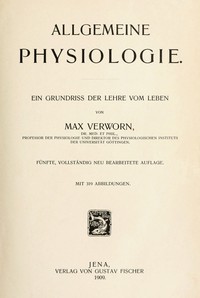
Allgemeine Physiologie by Max Verworn
Max Verworn's 'Allgemeine Physiologie' isn't a novel with a plot, but it has a powerful narrative drive: the quest to explain life through science. Published in the late 1800s, it represents a pivotal moment when biology was shaking off old, vague ideas and embracing chemistry and physics.
The Story
The 'story' is Verworn's systematic argument. He starts with the basic unit of life—the cell—and breaks down its functions: how it eats, breathes, moves, and responds to its environment. He then scales up, explaining how tissues and organs work, with a special focus on the nervous system. The central thread is his materialistic viewpoint. For Verworn, there is no 'vital spark' or special life force. Instead, every biological phenomenon, from a thought to a muscle twitch, is the result of physical and chemical processes we can, in principle, understand and measure.
Why You Should Read It
Reading this today is a trip. You get to stand shoulder-to-shoulder with a pioneer. You see the gaps in his knowledge—he didn't have DNA or modern neuroscience—but you also see his incredible intuition. His insistence that life obeys natural laws was revolutionary. It’s humbling and thrilling to see how much he got right using the limited tools he had. More than just facts, the book radiates a contagious passion for asking big questions and seeking solid answers. It’s the work of a mind utterly convinced that the universe, including us, is knowable.
Final Verdict
This isn't for everyone. It's a dense, historical scientific text. But if you're a science history nerd, a student of biology who wants to see the foundations of your field, or just someone fascinated by how great minds tackled the biggest mystery of all, it's a treasure. Think of it less as a manual and more as a time capsule from the front lines of a scientific revolution. Perfect for readers who love the 'aha!' moments in the history of ideas and don't mind a bit of intellectual heavy lifting.
This publication is available for unrestricted use. Use this text in your own projects freely.