1

Inventions of the Great War — A Reader’s Guide
3
0
Project Gutenberg
2014
Inventions; World War, 1914-1918 -- Technology
Readers of public-domain and historical texts
Project Gutenberg digital edition
en
Edition facts
Words: 70,938
Reading time: 309 min
Text sections: 10
Source:
Project Gutenberg record #45269
A 1919 account of WWI innovations by Scientific American's managing editor, focusing on American-origin inventions like the submarine, airplane, and machine-gun, and their countermeasures. Explains range-finders, observation balloons, and the tank's development with accessible technical detail.
Editorial Edition Score
4.8/5
★★★★★
★★★★★
Calculated from edition completeness, EPUB availability, text structure and catalogue metadata. Not a user rating.
Edition quality
Bond opens by claiming three American inventions—the submarine, airplane, and machine-gun—shaped the war's character, then pivots to the ironic task of overcoming them. His preface frames the book as a record of Yankee ingenuity tested by enemy adaptations, not a boast. The narrative voice is that of a technical journalist: precise, explanatory, and occasionally wry, as when he notes the tank was inspired by an American farm tractor but created by the British.
Explaining the Invisible: Range-Finding as a Window
Bond devotes considerable space to range-finding, using a simple analogy—the human eyes' limited separation—to introduce the principle. He describes the range-finder as a double telescope held at right angles, with prisms that spread vision artificially. The explanation is methodical: the instrument's length equates to spreading the eyes apart, and the angle of adjustment yields distance on a scale. He notes that battleships used twenty-foot versions with microscopes, while land forces relied on two observers stationed hundreds of yards apart, communicating by telephone. The prose is patient, building from basic geometry to practical military application. Bond's tone is that of a teacher, not a propagandist, and he grounds each technical point in a concrete image—the observer perched in a church steeple or atop a telegraph pole.
From Kite Balloons to Bird's-Eye Observation
The shift to aerial observation marks a change in pace. Bond contrasts earlier methods—kites towed from ships, Civil War captive balloons—with the modern kite balloon, a sausage-shaped gas-bag held on a slant by the wind. He describes its stabilizing features: an air-bag rudder and a tail of cone-shaped cups. The language becomes more kinetic, reflecting the subject's movement. Observers now telephone coordinates from these steadier platforms, revolutionizing accuracy. Bond's focus remains on the invention itself, not the drama of combat. He treats the balloon as a logical extension of the range-finder principle, carrying the observer higher to spread the metaphorical eyes farther apart. The section's rhythm accelerates as Bond moves from static ground-based methods to dynamic aerial platforms, mirroring the technological leap he describes.
The Tank as a Counter-Invention
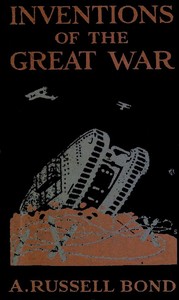
Bond presents the tank as the answer to the machine-gun and barbed wire, both American inventions. He credits British creation but notes its inspiration from an American farm tractor. The tone is matter-of-fact, avoiding nationalistic fervor. Bond's narrative voice here is analytical: he treats the tank not as a marvel but as a necessary solution to a tactical deadlock. The prose tightens, reflecting the urgency of the problem. He does not describe battles or heroics; instead, he frames the tank as an engineering response to a specific challenge. This section exemplifies Bond's method: he identifies a problem (machine-gun fire), links it to an earlier invention (barbed wire), and presents the counter-invention (tank) as a logical, if ingenious, step. The pace is brisk, the explanation clear, and the judgment reserved.
Bond's book rewards readers who enjoy step-by-step technical exposition. His voice is that of an engineer explaining to a lay audience: patient, concrete, and occasionally dry. The excerpts suggest a work that prioritizes clarity over narrative sweep. Readers should expect detailed descriptions of mechanisms—range-finders, balloons, guns—rather than strategic analysis or personal accounts. The preface's claim of American responsibility for the war's key technologies sets a thematic frame, but the body appears to deliver on its promise of technical explanation without jingoism.
Reader reflection
How will you remember this book?
Save your reaction, strongest insight, and memorable passage.
Your progress
0
/
10
2
Did this book hold your interest?
3
How likely are you to recommend this book?
4
How demanding did the text feel?
5
Did this book create an emotional response?
6
Which aspect of the book did you value most?
7
Did the book give you something worth debating?
8
Was the book moving at the right speed?
9
In one sentence, what did you learn?
10