1

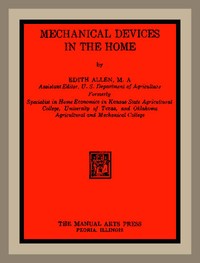
Mechanical Devices in the Home — A Closer Reading
1450
0
Project Gutenberg
2014
Home economics; Home economics -- Equipment and supplies; Domestic engineering; Household appliances
Readers of public-domain and historical texts
Project Gutenberg digital edition
en
Edition facts
Words: 51,691
Reading time: 225 min
Text sections: 13
Source:
Project Gutenberg record #46836
Edith Allen's 1922 manual guides householders in selecting, installing, and maintaining cooking, heating, lighting, and laundry appliances, with non-technical explanations of mechanical principles and practical repair advice.
Editorial Edition Score
4.8/5
★★★★★
★★★★★
Calculated from edition completeness, EPUB availability, text structure and catalogue metadata. Not a user rating.
Edition quality
Edith Allen addresses her 1922 manual directly to women, aiming to fill what she calls a “lack of material of this type which is non-technical enough for the use of home economics students and housewives.” The preface lists seven explicit goals, from guiding fuel economy to explaining the construction of electric and gas plants. Allen’s voice is brisk and instructional, assuming a reader who operates appliances daily but may not understand their inner workings. She writes as a former specialist in home economics at several agricultural colleges and as an assistant editor at the U.S. Department of Agriculture, grounding her authority in institutional experience rather than commercial endorsement.
Precision in Diction: The Language of Adjustment
Allen’s prose is marked by a recurring emphasis on adjustment and measurement. In the wringer chapter, she specifies that rollers “should be set close together” for thin articles and “far apart” for heavy ones. She gives exact pressure requirements: water motors “must receive more than 25 pounds of water pressure.” For centrifugal dryers, she instructs the user to “load so that it runs even and does not wobble.” These details reveal a writer who treats household work as a series of calibrated operations. The vocabulary is concrete—thumb-screws, clamps, perforated tubs—and avoids abstract praise. Allen’s diction consistently frames the home as a site of mechanical precision, not merely of domestic routine.
Voice and Audience: The Implied Operator
The book’s voice assumes a reader who is both capable and uninformed. Allen uses the imperative mood throughout: “Keep the rollers washed clean,” “Never leave a wringer with the pressure on the rollers,” “Load the basket full if there are clothes enough.” She warns against specific hazards—kerosene dissolves rubber, friction can ignite gasoline—and gives troubleshooting steps. The implied operator is a woman who may not know that oil rots rubber rollers or that gasoline vapors can spark. Allen does not condescend; she explains the why behind each instruction. For instance, she notes that centrifugal dryers can be used for dry-cleaning but must be operated “out of doors and at a slower speed.” This blend of caution and technical rationale shapes a distinct pedagogical tone.
Structure: From Principle to Procedure
Allen organizes each chapter by first describing a device’s construction, then listing care and operation steps. The wringer chapter, for example, opens with a definition: “The kind of wringer in most general use is the one made of two rollers rotating in opposite directions.” It then moves to adjustment, cleaning, and safety. This pattern—principle, then procedure—appears consistently. The centrifugal dryer section similarly explains the physics of rapid rotation throwing water outward before giving loading instructions. The structure mirrors Allen’s stated aim to “explain the principles” before guiding choice and use. It also reflects her background in extension teaching, where theory and practice are interwoven.
Recurring Details: The Material World of 1922
The excerpts are dense with period-specific materials and brands. Wringer rollers are made of “a composition of rubber.” Mangles have a stationary surface called a “shoe.” The laundry chapter references “American Ironing Machine Co.” and “Automatic Electric Washer Co.” in its acknowledgments. Allen’s advice to clean stained rollers with “a weak solution of ammonia” or kerosene, followed by immediate washing, assumes access to these chemicals. The centrifugal dryer doubles as a dry-cleaning machine, but only if operated outdoors to avoid gasoline fires. These details anchor the text in a specific technological moment—before synthetic fabrics, before automatic machines—when household work required active management of mechanical parts and chemical agents.
Allen’s manual rewards a reader who attends to its precise instructions and the reasoning behind them. The book is best approached as a primary document of domestic technology in the early twentieth century, not as a modern how-to guide. Readers interested in the history of home economics, material culture, or women’s technical education will find in its pages a systematic effort to translate engineering knowledge into household practice. The excerpts show a writer who believed that understanding a device’s construction was essential to using it well—a conviction that gives the book its lasting value.
Reader reflection
What was your reading experience?
Capture what you thought, learned, and would like to remember.
Your progress
0
/
10
2
How much did you enjoy the reading experience?
3
Would you encourage someone else to read it?
4
How easy was the book to follow?
5
How personally connected did you feel to the book?
6
How useful were the ideas in this book?
7
What did you appreciate most?
8
How strongly did the book affect you emotionally?
9
What is the main idea you are taking away?
10